
Emotional maturity Impacts Leadership

Some years ago I wrote a book review for an entry into the EQ market geared toward individuals and families. Now I am recognizing its larger relevance to the world of leadership. Below I will first share my summary of the book and then offer some applications for our growing gravitas as leaders ourselves and those we work for.
Adult Children of Emotionally Immature Parents, by Lindsay Gibson, PsyD. 2015 New Harbinger Publications
Primary Thesis. Drawing from personal clinical experience and extensive research, but presented in a highly readable style, Gibson proposes the idea that men and women who grow up in emotionally constricted homes tend to, in turn, become parents who try to use their children to fill the vacuum of their own unmet emotional needs. They become “Emotionally Immature Parents” (in one of four ways) who communicate implicitly and explicitly that you, as a child, cannot be an individual or have your own emotional needs…because you are here to meet my needs!
These are some of the symptoms of being the child of an EIP: rarely listened to, pressure to anticipate parents’ needs…but can’t do enough to make them happy, bound to an imposed role, boundaries disrespected, striving for attention, ashamed of having feelings or needs, unexpressed anger.
Four Types. While all EIPs tend to be self-involved, narcistic, insensitive, and emotionally unavailable, they also tend to sort themselves into four primary types…
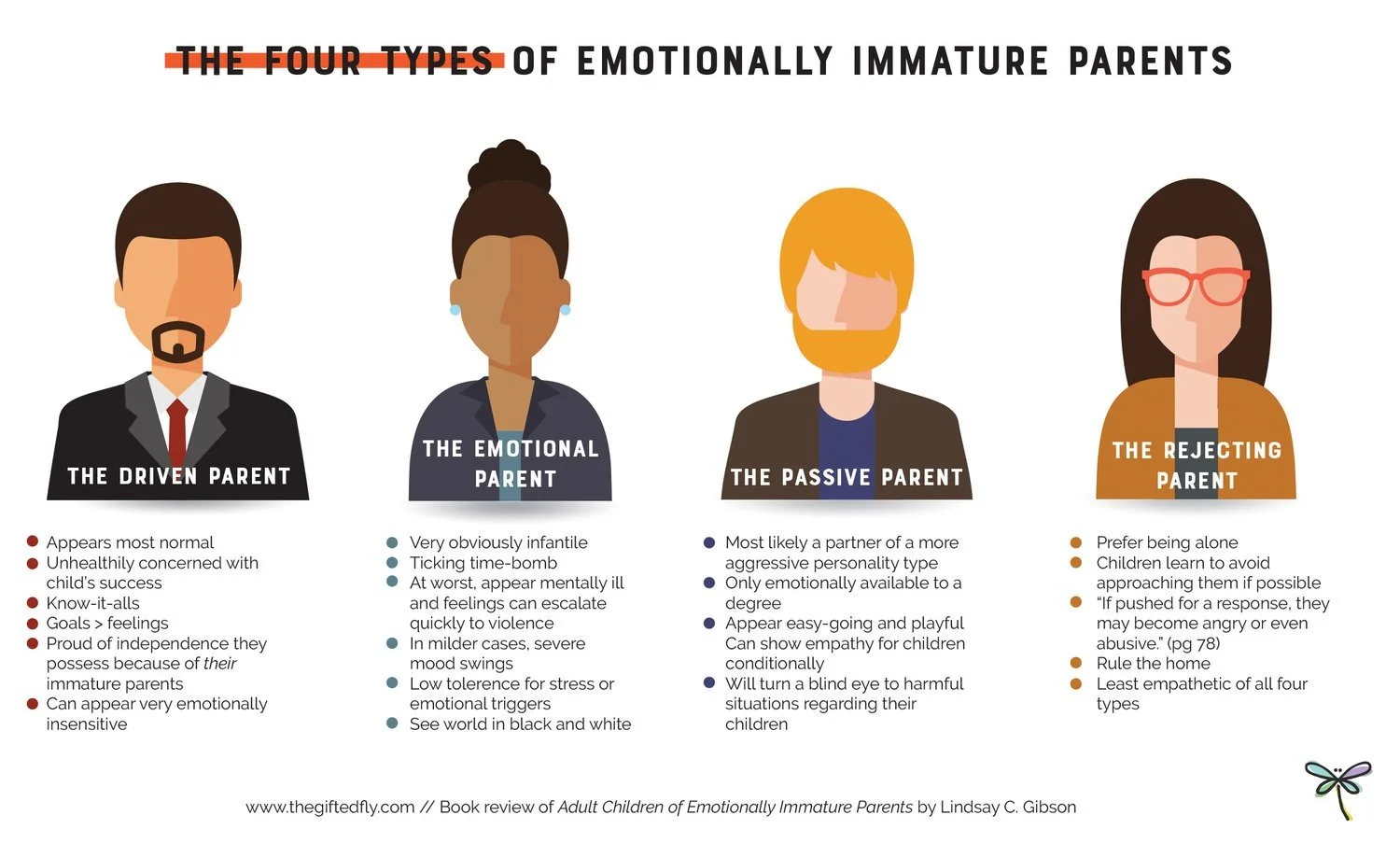
Leadership. Now let's reframe these archetypes into Emotionally Immature Leaders (EIL's).
The Driven Leader: pushes himself / herself while also pushing direct reports. Values the appearance of success more than success itself. Profit margins matter more than missional purposes. Appear over-confident and self-reliant, while trying to mask insecurity and anxiety. Emotionally unavailable.
The Emotional Leader: while perhaps not technically bipolar, mood swings are dramatic, reactive, and volatile. This leader type expends a lot of energy protecting their emotional equilibrium... but intruding on yours.
The Passive Leader: low-key, laid-back, goes along to get along. Will not challenge the status quo, even when the environment is toxic. Overly dependent upon the system and will not take risks to improve it.
The Rejecting Leader: Committed to power more than to people. Task-oriented and capable but utterly incoherent emotionally. Cannot understand or interpret themselves, you, or the communication between you. Aloof at best, dangerous at worst.
Strategies. Coping effectively with an EIL requires letting go of your assigned (co-dependent) role, whether fan or foil, letting go of the wishful fantasy that you can somehow earn this leader's loyalty or affection. Instead, you reclaim your power by recalibrating your expectations through these strategies:
Before lobbing this badge onto another person, first look into the mirror to discover whether you tend toward any of these dynamics in yourself. Which of the four types could be a potential pitfall for you... and how would you avoid that?
With your own boss, observe from a detached perspective. Respond to this leader from a calm, thinking perspective instead of emotional reactivity.
Express your desire or opinion…and then let go of expectations.
Set realistic goals for the relationship…while seeking meaningful intimacy elsewhere.ears ago I wrote a book review for an entry into the EQ market geared toward individuals and families. Now I am recognizing its larger relevance to the world of leadership. Below I will first share my summary of the book and then offer some applications for our growing gravitas as leaders ourselves and those we work for.